

We are on whatsapp/ viber- text/ call us on +91 8939792782 /+971 504602676

Get a Free Estimate or Second Opinion within 48 hours
All About
Acetabular Fracture
Symptoms
A fractured acetabulum is almost always painful. The pain is worsened with movement. If nerve damage has occurred with the injury, the patient may feel numbness, weakness, or a tingling sensation down the leg.
Causes
An acetabular fracture results when a force drives the head of the femur against the acetabulum. This force can be transmitted from the knee (such as hitting the knee against the dashboard in a head-on car collision) or from the side (such as falling off a ladder directly onto the hip). Depending upon the direction of the force, the head of the femur is sometimes pushed out of the hip socket, an injury called hip dislocation.
When the fracture is caused by high-energy impact, patients often experience extensive bleeding and have other serious injuries that require urgent attention.
Acetabular fractures are sometimes caused by weak or insufficient bone. This is most common in older patients whose bones have become weakened by osteoporosis. Although these patients do not often have other injuries, they may have complicating medical problems, such as heart disease or diabetes.
More about Treatment
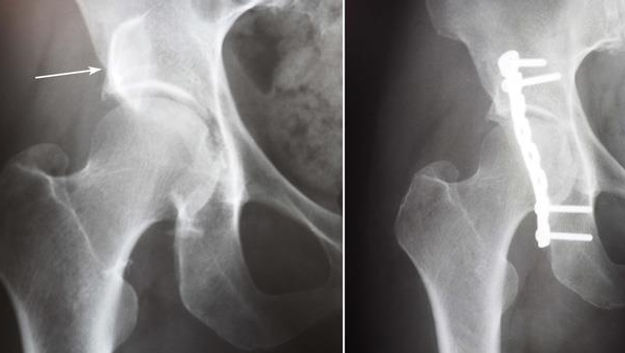
An acetabular fracture is a break in the socket portion of the "ball-and-socket" hip joint. These hip socket fractures are not common they occur much less frequently than fractures of the upper femur or femoral head (the "ball" portion of the joint).
The majority of acetabular fractures are caused by some type of high-energy event, such as a car collision. Many times patients will have additional injuries that require immediate treatment.
In a smaller number of cases, a low-energy incident, such as a fall from standing, may cause an acetabular fracture in an older person who has weaker bones.
Treatment for acetabular fractures often involves surgery to restore the normal anatomy of the hip and stabilize the hip joint.
FAQ on this Treatment
What is acetabular fracture?
An acetabular fracture is a break in the socket portion of the "ball-and-socket" hip joint.
What is the mechanism of acetabular fracture?
Fractures of the acetabulum occur when the head of the femur is driven into the pelvis. This injury is caused by a blow to either the side or front of the knee and often occurs as a dashboard injury accompanied by a fracture of the femur. Fractures of the acetabulum in young individuals usually result from a high energy injury like vehicular accident or feet first fall. In older individuals or those with osteoporosis, a trivial fall may result in acetabular fracture.
3-What are the types of acetabular fracture?
classification of acetabular fracture:
I - Simple fracture, anterior or posterior wall column
II – transverse fracture
III - T - Type fracture involving two columns
IV - Both columns fractures, floating acetabulum
How is acetabular fracture managed?
If the femur head is dislocated, it should be reduced as soon as possible, to prevent damage to its blood supply. This is preferably done under anesthesia, following which, leg is kept pulled by applying traction to prevent joint from dislocating. Surgical fixation using screws and plates may be required if the injury is complex.
What is the recovery time in acetabular fracture?
The patient may be allowed to stand and walk with help of support within about six to eight weeks. Full function may return in about three months.
What are the complications which may arise after the fracture?
Post traumatic arthritis, infection, nerve injury etc.